As artificial intelligence (AI) drives exponential demand for more computing power—all of it provided by data centers—our infrastructure is showing strain. Studies show that data centers will account for nearly half of U.S. electricity demand growth between now and 2030. Even if we can power the data centers, finding a place to build them is becoming harder, with more and more communities raising concerns about server farms that take away greenspace and monopolize power and water supplies to run and cool the facilities. Should these challenges be overcome, there are still issues with latency and processing power, making it hard for today’s terrestrial infrastructure to keep up with the application demands.
The next frontier in technology may depend on advancing into our next physical frontier—space.
Processing Data at the Source
Much of the world’s most valuable data is now generated in space, including Earth observation imagery, signals intelligence (SIGINT), and weather and climate data. GPS, smart city applications, and operational awareness for disaster response all rely on data from space-based satellites.
Satellites have served primarily as collection platforms—capturing imagery, signals, and environmental data, then transmitting that raw data back to Earth for processing. But as the collection power and the need for data grows, satellites are facing issues with latency and bottlenecks delivering that data back to earth.
Satellites as Data Centers
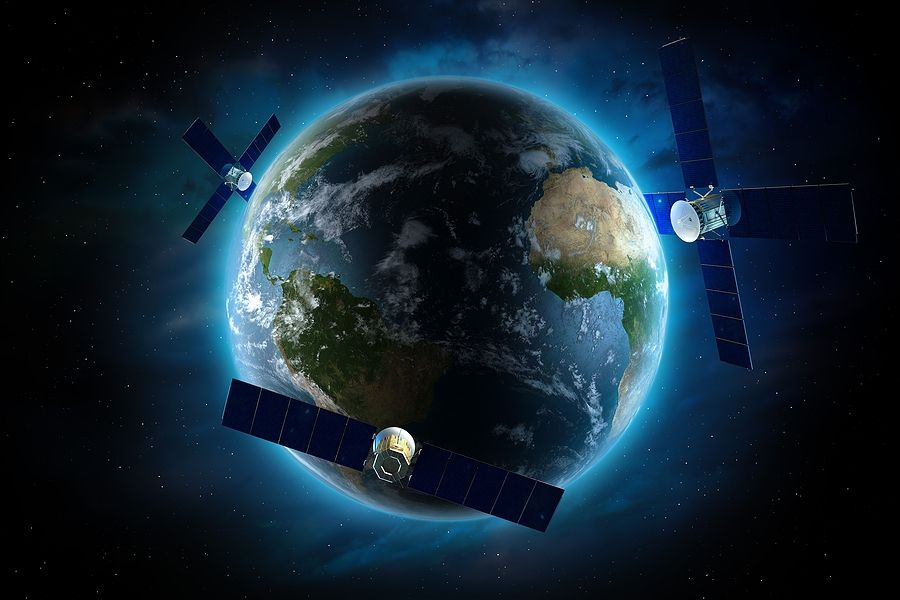
If we shift the vision of satellites as sensors to satellites as processors, these challenges can be solved. Moving edge-computing capabilities to satellites allows for data to be processed in orbit, with only actionable insights transmitted back to earth. For example, images captured by a satellite could go to an orbital data center to be converted into the appropriate format, while using AI to send back only the images that are needed for a specific mission or request.
Consider the following applications:
Intelligence, Surveillance, and Reconnaissance (ISR) – Processing imagery and signals in orbit enables faster target identification and significantly reduces the need to transmit raw data—potentially cutting bandwidth requirements by over 90% in some scenarios.
Disaster Response – Orbital compute allows real-time analysis of damage for coordinating responses even when terrestrial infrastructure is degraded.
Space Domain Awareness – With increasing congestion in orbit, real-time tracking and analysis of space objects becomes essential.
Autonomous Systems – Edge compute in orbit provides the low-latency intelligence backbone required for autonomous operations.
But to reach this promise, a number of challenges need to be addressed.
Impact on Natural Resources
Orbital data centers could run on practically unlimited solar energy without interruption from cloudy skies or nighttime darkness. It also eliminates the cooling burdens with more favorable thermal conditions.
On the other hand, there are real concerns about the environmental impact of moving compute power to the skies, including the increase in space debris and the increase in needed rocket launches to get data-center satellites in orbit.
Operational Roadblocks
Beyond the environmental impacts, there is a huge economic cost involved in moving data centers to space. While costs are decreasing, SpaceX’s Falcon 9 rocket, for example, still averages $1,500/kg to launch a payload into space.
Additionally, once in orbit, the maintenance challenges and costs can be untenable. Radiation in space can degrade hardware performance, requiring specialized (and often less powerful) components. Currently, we do not have methods to protect chips from these high levels of radiation exposure. And since sending maintenance and parts up to a satellite on a regular basis is not feasible, we need to develop better remote fixes for the many things that could go wrong with different parts of the system.
Tracking the Future of Data Centers in Space
As data continues to grow in volume, velocity, and strategic value, the ability to process it closer to its source will define the next generation of digital infrastructure. This could look like a multi-layered distributed architecture that includes:
Low Earth Orbit (LEO): Edge processing and real-time inference
Medium Earth Orbit (MEO): Data aggregation and routing
Geostationary Orbit (GEO): Persistent communications and orchestration
To stay on top of the progress of space as a data center, check out these resources:
MILSATCOM USA 2026 (June 8, 2026; Arlington, VA) – This event is dedicated to exploring the future of military satellite communications across the US DOD. Key topics include COMSATCOM updates and SATCOM Policy developments, innovations in SATCOM for Special Forces, and cybersecurity solutions for space systems.
Data Centers & National Security Summit (June 24, 2026; Oxon Hill, MD) – This forum aims to explore the technologies and strategies that ensure data centers operate efficiently and securely, with a focus on power management, cooling systems, and operational resilience.
The New Space Tech Stack (white paper) – The future of space operations is being reshaped by AI, edge computing, and immersive tech. Government agencies are leveraging these tools to extract insights from satellite imagery, streamline disaster response, and design better space assets faster and more affordably. Innovations like neural networks and SAR data are turning floods, wildfires, and climate change into actionable intelligence.
Sustaining the U.S. Edge in Remote Sensing, Launch, and Advanced Technologies for National Security (white paper) – Remote sensing and space-launch technologies are fast becoming critical components of national security. This report from CSET outlines how the U.S. can maintain its strategic edge by strengthening public-private collaboration, investing in next-gen platforms, and securing key supply chains.
Data Center Energy Impacts and State Responses (Research Report) – As AI adoption accelerates, data centers are rapidly expanding and driving some of the fastest-growing electricity demands in the country. States are now grappling with rising power costs, grid strain, carbon implications, and the challenge of balancing economic development with energy reliability. In response, legislatures across the U.S. are creating new tariffs, adjusting permitting rules, incentivizing green standards, and exploring ways to keep residential customers from absorbing the cost of these massive loads.