Resolving Geolocation Ambiguity for Emitters with Uncertain Identity and Classification
Modern Electromagnetic Warfare Operations (EMO) relies on mission datasets that predict and catalogue emission signatures to support emitter Identity (specific source) and Recognition (type or category). These datasets feed the Recognised Electromagnetic Picture (REMP) and the Common Operating Picture (COP). However, real-world conditions often diverge from predictions: variations in equipment, probabilistic signal observations, and incomplete TECHINT analysis can introduce uncertainty.
When Identity or Recognition is ambiguous, geolocation accuracy also suffers. For example, multiple identical emitters observed through Lines of Bearing (LOB) can generate numerous candidate positions, of which only some are correct. As emitter density increases, this ambiguity grows exponentially, degrading Situational Awareness (SA) and operational decision-making.
This session explores the underlying problem space of LOB-based geolocation under ambiguity, including how observer count, altitude, and system scaling influence the number of candidate solutions and the probability of identifying the correct emitter location. It introduces a geometric, equipment-agnostic discrimination method based on a graph data-structure with probabilistic agreement between observer pairs, enabling probability imbalance to isolate true solutions.
Unlike approaches that rely on tracking, parametric comparison, or Machine Learning (ML), this method operates at the detection stage, reducing false solutions without added latency or trust concerns. It supports coalition operations by decoupling reliance on emitter identity and enabling geolocation of previously unencountered emitters. Operational use cases demonstrate how asset tasking can further bias probabilities to improve solution accuracy, preserving SA in complex and dynamic EW environments.
LEARNING OBJECTIVES: Attendees will learn/takeaway:
- Outcome 1: Understand the challenges of Line of Bearing (LOB) geolocation and how emitter ambiguity degrades accuracy and situational awareness.
- Outcome 2: Analyze how system factors—such as number of observers, altitude, and linear scaling—lead to exponential growth in false geolocation solutions.
- Outcome 3: Apply a graph-based, equipment-agnostic geolocation discrimination method that reduces false solutions and supports coalition EW operations without reliance on tracking or ML
TARGET AUDIENCE:
EW practitioners, particularly those involved in SIGINT analysis and geolocation.
Event Topic
Defense, MilitaryRelevant Audiences
All Military, All Federal Government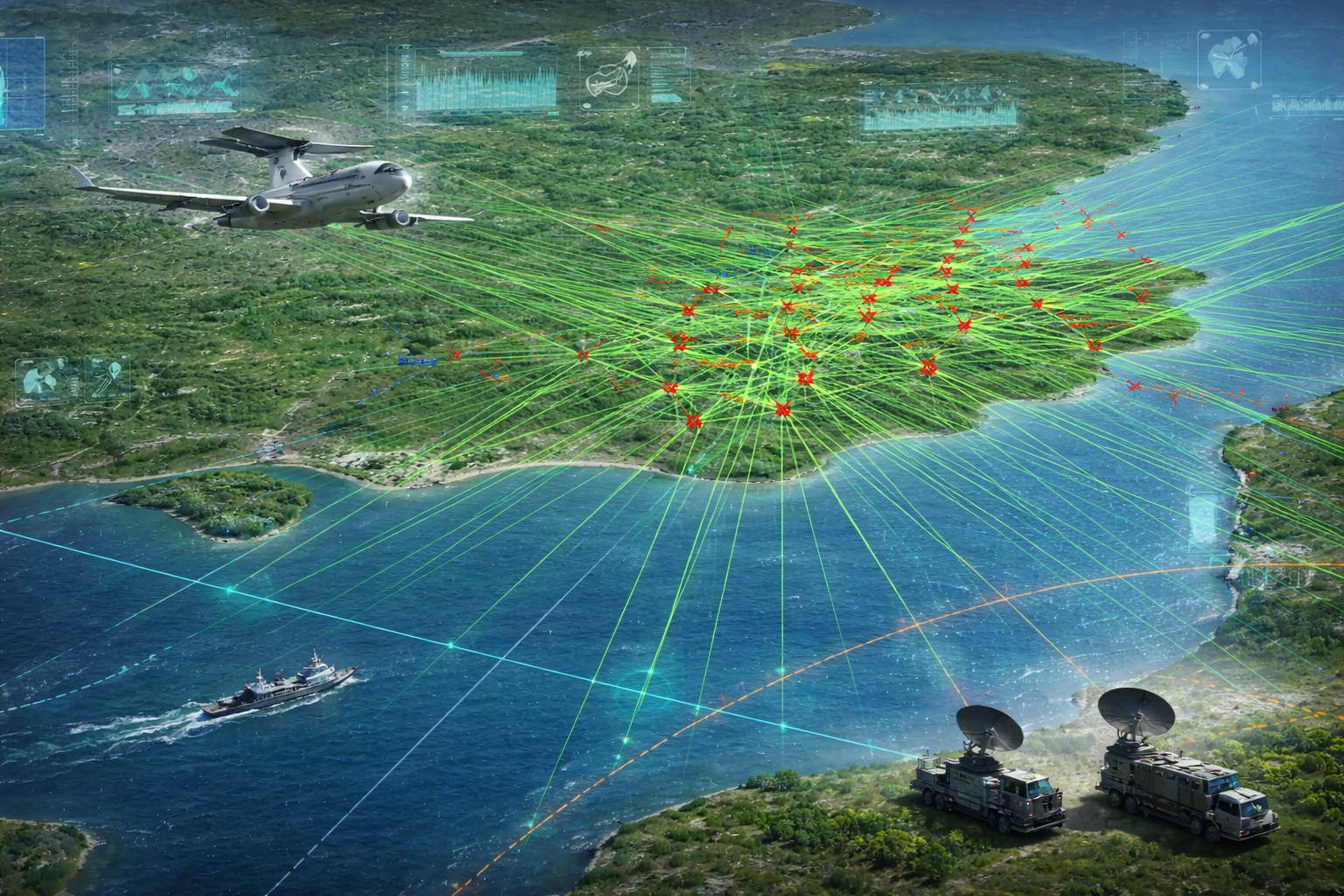
AOC Members:
$ 0.00
Non-Members of AOC:
$ 25.00