ATARC
ATARC is a 501(c)(3) non-profit organization that provides a collaborative forum for government, academia and industry to identify, discuss and resolve emerging technology challenges.

Upcoming ATARC Events
Please note — this demonstration is a government-only audience. You must register with your government email address to be admitted (.gov or .mil). If you are a contractor, you must register as representing your government agency. If you have any questions, please email Amy Karpowicz at [email protected].
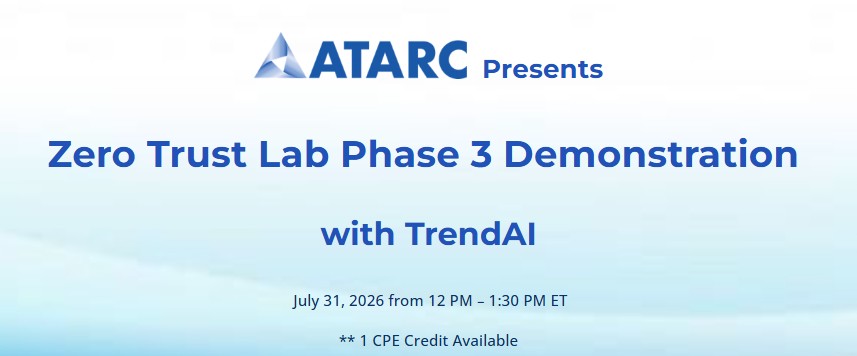
This presentation demonstrates how TrendAI Vision One delivers Zero Trust as a unified, AI-driven platform rather than a collection of point tools. Every capability shown maps directly to the NSA’s seven pillars of Zero Trust, with native sensors and an agentic AI layer operating over a single data lake. Because the platform integrates identity management, endpoint, workload, SOAR, and SDN — and runs both cloud-agnostic and on-premises — it provides continuous, policy-driven enforcement across the full mission environment instead of stitching together disconnected controls.
The session will walk through the platform in action across the use cases that matter most to federal security and governance teams. These include sensitive-data classification that drives downstream access decisions, vulnerability and incident management enriched with AI-based attack-path prediction, and governance spanning the broader ecosystem, software supply chain, and SBOMs. Throughout, AI is used not just to detect but to prioritize and act — automatically ranking risk and cutting service tickets so analysts spend their time remediating rather than researching and documenting.
During this session, TrendAI will actively demonstrate the ATARC Zero Trust Lab Phase 3 AI Track Use Cases, walking through the platform in action across critical federal security and governance workflows.
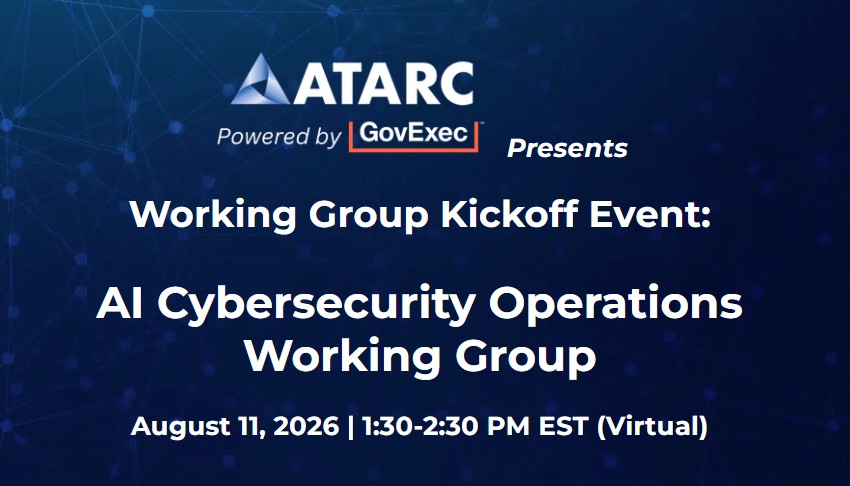
Artificial intelligence is transforming how federal agencies detect threats, analyze intelligence, and respond to cyber incidents. To support this evolution, ATARC is launching the AI Cybersecurity Operations Working Group, bringing together the Cyber AI Convergence and Threat Intelligence Working Groups into a single community dedicated to advancing AI-enabled cyber operations and addressing the security challenges of AI-enabled systems.
Join government leaders, industry experts, and academic researchers for the inaugural roundtable as we launch this new working group. The discussion will examine how agencies operationalizing AI across Security Operations Centers (SOCs):
- Integrating AI into threat intelligence and threat hunting
- Leveraging automation to improve cyber defense
- Securing increasingly AI-enabled environments
- Combating adversarial AI
- Governance and risk management
- Data ingestion and visibility
- Red and purple teaming
- Workforce transformation
- Emerging architectures for next-generation cyber operations
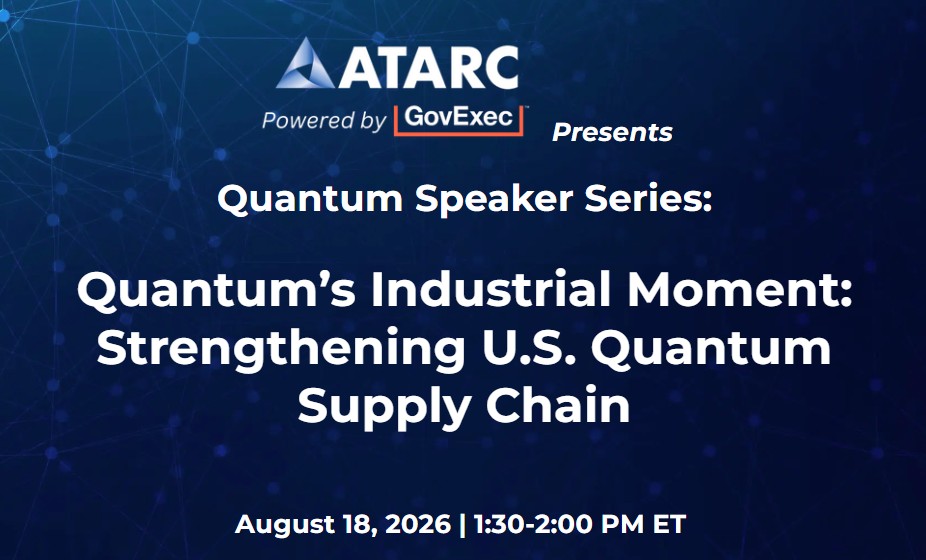
Quantum technologies are approaching a critical inflection point. Over the next three to five years, advanced quantum sensors and computers once confined to laboratories will begin to have real-world impact, with significant economic and national security implications. But the United States faces a major industrial challenge: its quantum supply chains are thin, globally dispersed—in some cases reliant on China and Russia—and poorly positioned for the transition to commercial utility, posing significant vulnerabilities for quantum’s continued development and deployment. This talk will offer a framework for assessing these gaps across quantum hardware modalities, enabling technologies, and vulnerability categories, as well as recommendations to strengthen the industrial foundations of U.S. quantum leadership.

November 19 @ 8:00 AM - 3:00 PM

December 10 @ 8:00 AM - 3:00 PM